
Yes, thermal curtains help—but here’s the catch: they work best when you install them correctly. I’m talking floor-to-ceiling coverage with proper sealing, not just hanging fabric over your window. Heavy, multilayer curtains with reflective linings trap still air and slow heat loss by up to 4°C during cold periods. However, they’re most effective when paired with weatherstripping and other window treatments. Curtains alone won’t solve persistent cold problems, but they’re an important piece of your insulation strategy that deserves attention.
Do Thermal Curtains Actually Reduce Heat Loss Through Windows?
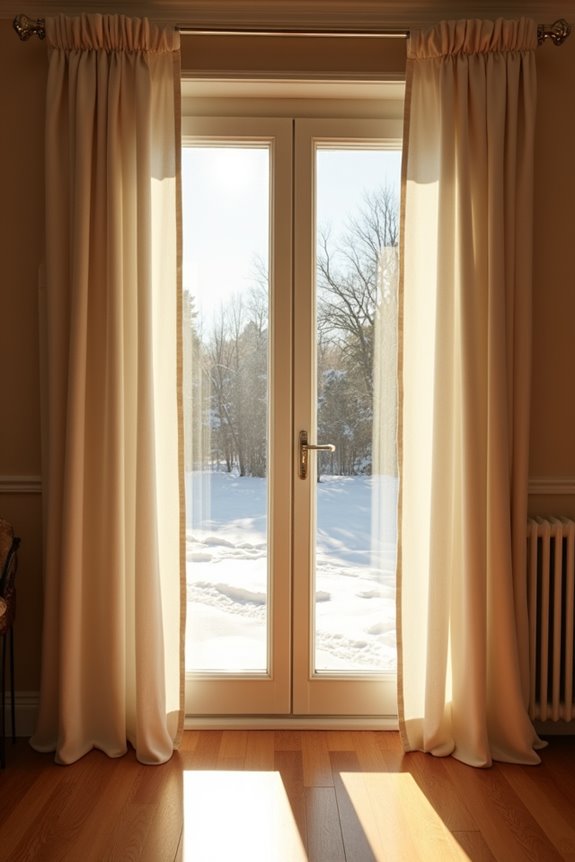
Have you ever sat near a window on a cold winter day and felt that unmistakable chill creeping into the room? You’re not alone. Thermal curtains help reduce heat loss by creating an insulating air gap between fabric and cold glass. This barrier slows convection and keeps your indoor air warmer.
Dense, multilayer curtains with reflective linings work best. They block radiant heat effectively while stabilizing room temperatures. Properly fitted curtains—covering entire windows with minimal gaps and reaching the floor—lower heating bills.
The key isn’t magic; it’s physics. Your thermal insulation improves when curtain edges seal tightly against walls. While curtains lack a standard R-value, layered installations with quality backing create measurable warmth improvements during typical winter conditions.
How Much Heat and Money Can Thermal Curtains Save?

I’ll show you exactly what thermal curtains can do for your heating bills and comfort level. You’re looking at real numbers here: a quality lined curtain setup can lower your indoor temperature by up to 4°C during heat events, which translates to meaningful reductions in your heating costs when winter arrives. The financial payoff depends on your current energy usage, local climate, and how consistently you actually use the curtains—but most households see noticeable savings within the first heating season.
Energy Savings Quantified
When you’re staring at your heating bill in January, you might wonder: just how much can thermal curtains actually save you?
Here’s what we know: thermal curtains with four-layer setups deliver serious insulation performance. You’ll see real energy savings through their multi-layer barrier that traps still air and reduces heat loss through windows.
Real-world results show:
- West-facing rooms can cool by approximately 4°C during peak sun exposure
- Full-floor length coverage amplifies effectiveness significantly
- Proper side sealing prevents convection and air leakage
- Combined treatments with window films maximize heat reduction
- Monthly heating costs decrease measurably with consistent use
The investment pays dividends. While curtains alone lack standard R-values, their practical impact on your home’s thermal performance is clear. Pairing thermal curtains with proper installation changes your windows from energy drains into insulated assets.
Financial Return Analysis
Most of us don’t realize just how much money slips away through our windows each winter—but the numbers are eye-opening. Since roughly 30% of home heating energy escapes through windows, installing quality thermal curtains becomes a smart financial move.
Here’s what makes the math work: thicker, lined curtains reduce heating bills noticeably. Installation factors matter tremendously—floor-to-ceiling coverage and side sealing maximize performance. A mid-range thermal curtain costs $150–$300 per window, yet energy savings accumulate quickly.
When you combine thermal curtains with other treatments like window films or pelmets, your overall heating reduction amplifies considerably. Many homeowners report recovering their investment within 2–3 years through lower utility bills.
You’re not just buying window coverings; you’re investing in comfort and long-term savings that benefit your wallet.
How Thermal Curtain Materials Trap Warm Air
Have you ever noticed how the area near your window feels colder than the rest of your room, even when your heating’s running?
That’s where thermal curtains work effectively. They function by creating an insulating air space between the glass and the fabric. This still pocket of air slows down heat transfer significantly.
Here’s what makes them effective:
- Thermal lining adds conductive resistance and blocks drafts
- Multilayer construction traps warm air more efficiently than single fabrics
- Foam-backed linings increase overall mass and reduce heat loss
- Proper fitting (pelmet and floor-length) minimizes air leakage around edges
- Dense materials create better insulation performance
The process works when that air gap forms. Your curtains stay cool against the window while your indoor air stays warmer. It’s effective thermal engineering we can all benefit from.
What Curtain Materials Actually Block Heat
I’ve learned that not all curtains perform equally—the materials you choose make a real difference in how much warmth stays trapped inside your home. The three key factors that determine a curtain’s heat-blocking ability are thermal backing and linings, fabric thickness and density, and reflective layer performance, each working together to stop heat from escaping through your windows. Understanding how these components function separately and together helps you pick curtains that actually deliver the thermal protection your home needs.
Thermal Backing and Linings
When you’re trying to keep warm air from escaping through your windows, here’s what you need to know: not all curtain fabrics work the same way. I’ve discovered that thermal backing and insulating linings make a real difference in how effectively curtains trap heat.
Here’s why these upgrades matter:
- Thermal backing reduces conductive heat transfer through the fabric itself
- Multi-layer linings create thick air pockets that trap still air effectively
- Foam-backed materials enhance insulation beyond standard blackout fabrics
- Three-pass linings provide superior heat retention compared to single-layer options
- Metallic backings reflect radiant heat back into your room
I’ve found that investing in curtains with built-in thermal linings gives you noticeably warmer windows. You’re adding an extra insulation layer that standard curtains simply can’t match, making your heating efforts significantly more efficient.
Fabric Thickness and Density
Why does a heavyweight velvet curtain feel warmer than a thin cotton one? The answer lies in fabric thickness and density. Dense textiles trap more air within their fibers, creating natural insulation that stops heat from escaping through your windows. Think of it like wearing a thick winter coat versus a t-shirt—the heavier material simply works harder.
I’ve noticed that curtains with substantial weight make a real difference. Lightweight fabrics let warmth slip through, while denser materials actively resist heat transfer. When you pair thick curtains with a thermal lining, you’re creating a powerful barrier that blocks radiant heat and reduces conductive loss.
The thickness matters because air pockets within dense fabrics act as tiny insulators. This combination turns ordinary window coverings into genuine thermal protectors, keeping your home noticeably warmer.
Reflective Layer Performance
Now that you understand how fabric thickness creates insulation, it’s time to look at what’s actually happening inside those layers. Reflective layers work differently than many people expect. They don’t create an R-value like traditional insulation does. Instead, they block radiant heat—that invisible energy radiating from your windows.
Here’s what reflective layers actually do:
- Block infrared radiation from escaping through glass
- Reduce heat transfer by reflecting warmth back inside
- Work best when paired with thick insulating materials
- Improve thermal performance when layered strategically
- Function most effectively on interior surfaces facing windows
The reality? A reflective backing alone won’t keep your home warm. You need that backing combined with dense fabric and proper air gaps. That’s when your curtains become genuine heat-trapping powerhouses, working together as an integrated system.
Why Thermal Curtain Fit and Length Matter More Than You Think
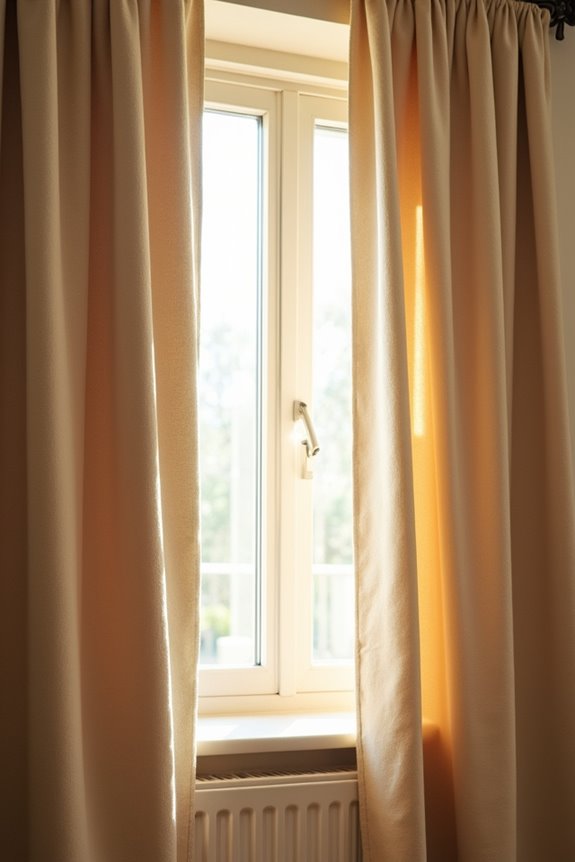
Ever notice how cold air seems to sneak around your curtains no matter how heavy they are? That’s because proper fit matters tremendously. When curtains don’t reach the floor or have gaps at the sides, cold drafts bypass your fabric entirely, and convection continues behind the curtain anyway.
Floor-length curtains create a thermal barrier that seals both edges and prevents leakage around the bottom. This still air trapped between your window and the fabric acts as insulation, lowering heat loss significantly.
I’ve learned that a good pelmet or top seal also minimizes warm air flowing down into gaps between curtain and window. Combine these elements—proper length, side seals, and top coverage—and you’ll feel the thermal performance difference you’ve been hoping for.
Installing Thermal Curtains Correctly: Sealing Edges and Gaps
I’ll show you how to install thermal curtains effectively by focusing on three installation techniques. You’ll need to measure your window openings precisely, seal gaps with weatherstripping, and maximize fabric overlap coverage—three steps that work together to eliminate the air leaks that undermine even the best thermal fabrics. Getting these details right means the difference between curtains that look nice and curtains that actually keep your home warmer.
Measuring Your Window Openings
Why do so many people install thermal curtains that don’t actually seal out the cold? They’re measuring wrong. I learned this the hard way after buying expensive window coverings that left gaps everywhere.
Accurate measurements prevent air leakage and maximize your insulation investment:
- Measure from ceiling to floor, including the wall space above the window frame
- Extend measurements 8–12 inches beyond the window on each side for proper overlap
- Account for pelmet or rod placement to eliminate gaps where cold sneaks through
- Measure width at three points (top, middle, bottom) since walls aren’t always perfectly straight
- Add extra fabric length for floor-length coverage that traps still air effectively
When I measured precisely and ordered curtains covering the entire opening plus margins, I noticed the difference immediately. That’s what proper sealing does—it works.
Sealing Gaps With Weatherstripping
Even perfectly measured fabric can’t do its job if cold air sneaks around the edges. I learned this the hard way when my heating bills didn’t drop as much as I’d hoped.
The solution? Weatherstripping and door/window seals. I applied self-adhesive foam strips around my window perimeters, creating a tight seal that keeps warm air trapped between the curtain and glass. Brush weatherstrips work well too, especially along the sides where air gaps commonly form.
This step improved my curtains’ effectiveness. By sealing those sneaky passages where cold air bypasses everything, I’ve maximized heat retention throughout my home. It’s one of those unglamorous fixes that actually delivers real results—something every homeowner serious about comfort should consider.
Maximizing Fabric Overlap Coverage
Weatherstripping does half the job, but here’s what I discovered: those seals only work if your curtains actually cover the window properly. I realized my fabric overlap was leaving gaps where warm air escaped—basically defeating my entire thermal layering strategy.
Here’s what improves your air sealing efforts:
- Extend curtains 8–12 inches past window edges on each side
- Stack fabric fully closed to eliminate side gaps completely
- Install floor-length panels reaching your baseboards
- Use heavy, dense fabrics that trap still air effectively
- Combine overlap with pelmet boxes for superior draft prevention
When I stopped leaving those exposed window edges and switched to full coverage, I actually felt the difference. Your curtains become a genuine thermal barrier—not just decoration. That’s when the real insulation happens.
When to Open and Close Curtains for Maximum Warmth
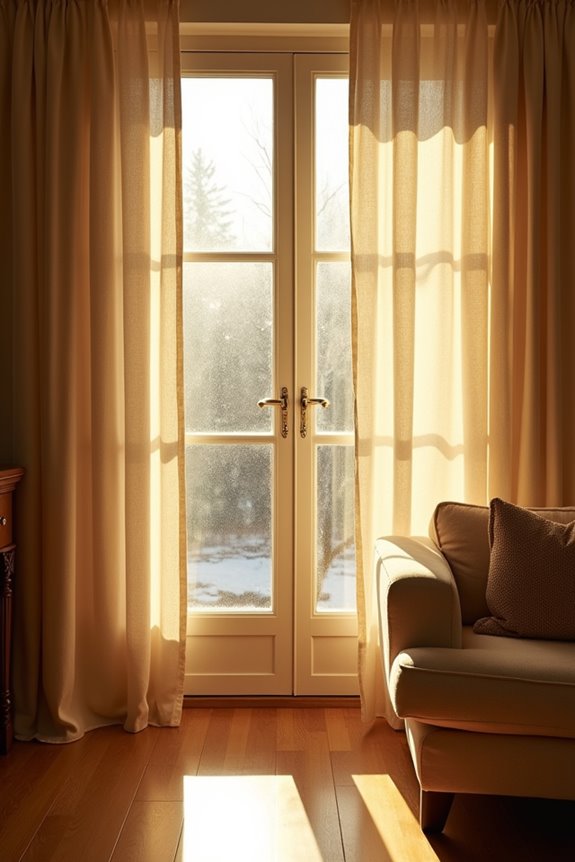
Timing really matters when you’re trying to use your curtains as a heat-trapping tool. I’ve learned that maximizing your curtains’ insulation power isn’t complicated—it’s about working with the sun’s natural rhythm.
| Time of Day | Action | Why It Works |
|---|---|---|
| Early morning | Open curtains | Capture free solar heat |
| Midday | Keep open | Maximize sunlight contribution |
| Late afternoon | Begin closing | Prepare for evening cooling |
| Dusk | Close fully | Trap accumulated warmth inside |
| Nighttime | Keep closed | Prevent convection heat loss |
During daylight, I open mine wide to let sunshine warm my space naturally. When dusk arrives, I close them completely. This simple habit—paired with heavy, thermal curtains—creates an air pocket that prevents convection from stealing your warmth. You’re creating your own insulation system without extra energy costs. It’s practical and effective.
Pair Thermal Curtains With Weatherstripping, Window Film, and Insulated Shades
While closing your curtains at dusk definitely helps trap warmth, curtains alone don’t stop all heat loss. Layering multiple solutions creates an effective insulation system that will show up on your heating bill.
Here’s what works best together:
- Weatherstripping seals drafty gaps around window frames, eliminating cold air infiltration
- Thermal curtains with thermal lining block radiant heat from escaping through glass
- Insulated shades with honeycomb structures trap air pockets for added R-value
- Window film reduces solar heat gain and minimizes temperature fluctuations
- Proper installation—floor-length curtains with sealed sides—maximizes heat retention
When I combined thermal curtains with weatherstripping, I reduced winter drafts significantly. Adding insulated shades underneath enhanced performance even more. These layered treatments work synergistically, creating multiple barriers against heat loss. Many homeowners find that smart combinations deliver measurable energy savings.
DIY Thermal Curtain Linings on a Budget
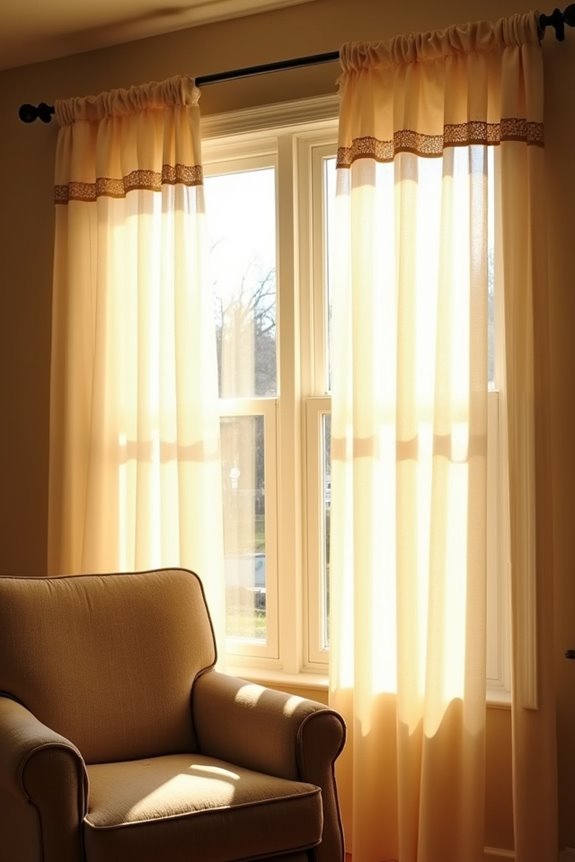
You can retrofit your existing curtains into energy-efficient insulators without spending hundreds of dollars on replacements. A DIY thermal lining retrofit costs very little while improving your home’s warmth.
Fleece, PVC shower curtains, or layered fabrics create an air-filled barrier that reduces heat transfer through windows. The benefit comes when that gap sits between the lining and glass—it minimizes convection losses.
| Material | Cost | Durability | Ease |
|---|---|---|---|
| Fleece | Low | Good | Easy |
| PVC Shower Curtain | Very Low | Fair | Very Easy |
| Blackout Fabric | Medium | Excellent | Moderate |
Proper installation matters. Make certain curtains reach the floor, seal sides with a pelmet, and maintain airflow space. You’ve invested in comfort affordably—that’s real energy efficiency.
Mistakes That Kill Curtain Insulation
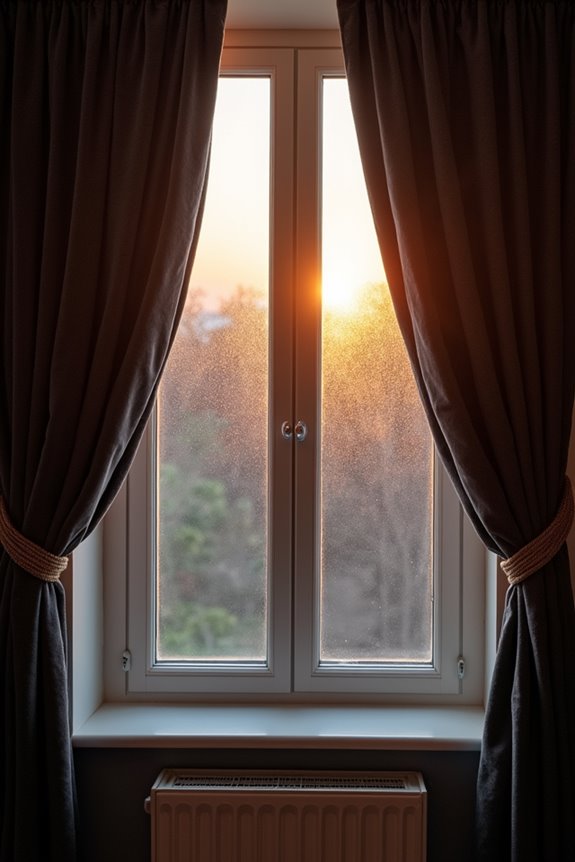
Even with the best thermal lining materials, you can sabotage your curtains’ insulation performance through common installation and usage mistakes.
Even the finest thermal linings fail when installation mistakes sabotage your curtains’ insulation performance.
I’ve learned that gaps are the enemy of effective curtain insulation. When you leave spaces around edges or fail to reach the floor, you’re letting warm air escape through those openings. Your multi-layer lining only works when it creates a proper air pocket against the window.
Here’s what kills your thermal performance:
- Leaving gaps on sides or at the floor
- Installing curtains too short to seal properly
- Forgetting pelmets that reduce top convection
- Opening curtains during cold nights
- Using lightweight fabric instead of dense materials
The truth? Your curtain insulation depends on complete coverage. I’ve seen people invest in quality linings, then ruin everything by hanging them poorly. Seal those edges. Reach that floor. You’ll notice the difference right away.
How Thermal Curtains Compare to Window Film and Weatherstripping
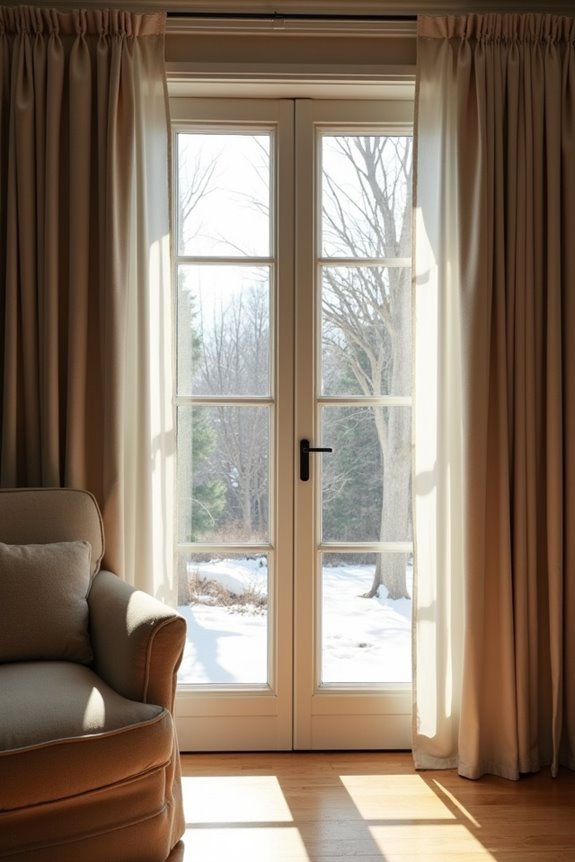
Thermal curtains aren’t your only weapon against heat loss—and honestly, they’re not always the strongest one. When I’m serious about keeping my home warm, I layer my defenses strategically.
Weatherstripping around window frames stops cold air from sneaking through cracks, addressing convection directly. Window film, meanwhile, tackles radiant heat by reflecting it away before it enters. Think of it as your first line of defense.
Thermal curtains work best alongside these tools. Heavy fabrics with three-pass lining handle conductive heat transfer, but they perform better when combined with exterior solutions. I’ve found that window film plus thermal curtains outperforms either option alone—particularly during cooling seasons.
The most effective approach combines all three methods, creating multiple barriers that work together seamlessly.
Thermal Curtains in Your Complete Home Insulation Plan
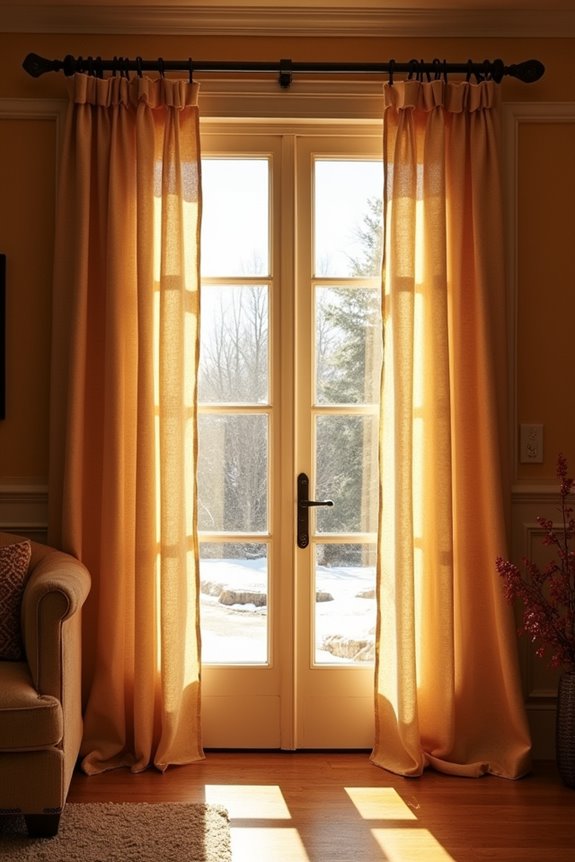
Now that you understand how thermal curtains stack up against other heat-loss solutions, it’s time to think bigger. Layering your insulation strategies creates an effective system. Thermal curtains aren’t standalone solutions—they’re necessary components in a comprehensive approach to keeping your home warm.
Here’s what I recommend combining:
- Thermal curtains with proper installation covering entire windows
- Window films reducing summer heat gain by up to 30%
- Weatherstripping sealing air leaks around frames
- Cellular shades adding extra insulation layers
- Heavy-duty hardware preventing gaps and sagging
When you coordinate these solutions, you’re not just reducing heat loss—you’re creating multiple barriers that work together. Energy bills dropped significantly once I stopped treating thermal curtains as isolated fixes and started viewing them as part of my home’s complete insulation strategy.
When Thermal Curtains Alone Won’t Keep You Warm

Why do some people install expensive thermal curtains, only to find their bedrooms still feel chilly on winter nights? The truth is, curtains insulation works best alongside other solutions. Even premium multilayer fabrics can’t overcome air leaks around your window frames or external shading issues from poorly sealed eaves. Thermal curtains alone won’t solve persistent cold problems. They trap still air between fabric and glass, but gaps around windows undermine this benefit significantly. You’ll need draught exclusion measures, proper heating control, and actual wall insulation working together. Think of thermal curtains as one tool in your toolkit, not your complete solution. Combining them with weatherstripping, caulk, and strategic heating creates the warmth you’re looking for.